Brachistochrone
Background
The brachistochrone asks for the curve along which a bead, released from rest and moving without friction under uniform gravity, reaches a lower point in the least time. Its solution is a cycloid rather than a straight line, making it a standard test for optimal-control and calculus-of-variations methods.
Problem formulation
Here \(y\) is positive downward and the path angle \(\theta\) is measured from the downward vertical. The minimum-time problem is
The final speed and final time are free.
Variables and units
| Symbol | Meaning | Unit |
|---|---|---|
| \(t\) | Time | s |
| \(x\) | Horizontal displacement | m |
| \(y\) | Downward displacement | m |
| \(v\) | Speed along the curve | m/s |
| \(\theta\) | Path angle from the downward vertical | rad |
| \(g\) | Gravitational acceleration | \(9.81\ \mathrm{m/s^2}\) |
Modeling choices
Using downward displacement keeps gravitational acceleration positive in the model. The speed constraint excludes a nonphysical reversal of the path parameter, and the angle bounds select monotone motion to the right and downward. The initial guess follows a straight descending path with speed \(v=\sqrt{2gy}\), which is consistent with conservation of mechanical energy.
Run the example
From the repository root, run:
To save the figure without opening a window:
Key implementation
import numpy as np
import sympy as sp

from pockit.lobatto import System, linear_guess

system = System(0)
phase = system.new_phase(["x", "y", "speed"], ["path_angle"])
_, _, speed = phase.x
(path_angle,) = phase.u

phase.set_dynamics(
    [
        speed * sp.sin(path_angle),
        speed * sp.cos(path_angle),
        9.81 * sp.cos(path_angle),
    ]
)
phase.set_integral([1.0])
phase.set_phase_constraint(
    [speed, path_angle], [0.0, 0.0], [np.inf, np.pi / 2.0]
)
phase.set_boundary_condition([0.0, 0.0, 0.0], [2.0, 2.0, None], 0.0, None)
phase.set_discretization(10, 8)
system.set_phase([phase])
system.set_objective(phase.I[0])

guess = linear_guess(phase, 0.0)
guess.t_f = 1.0
The complete example solves with Ipopt, constructs the analytical cycloid from the endpoint geometry, and checks the numerical travel time against it.
Verified result
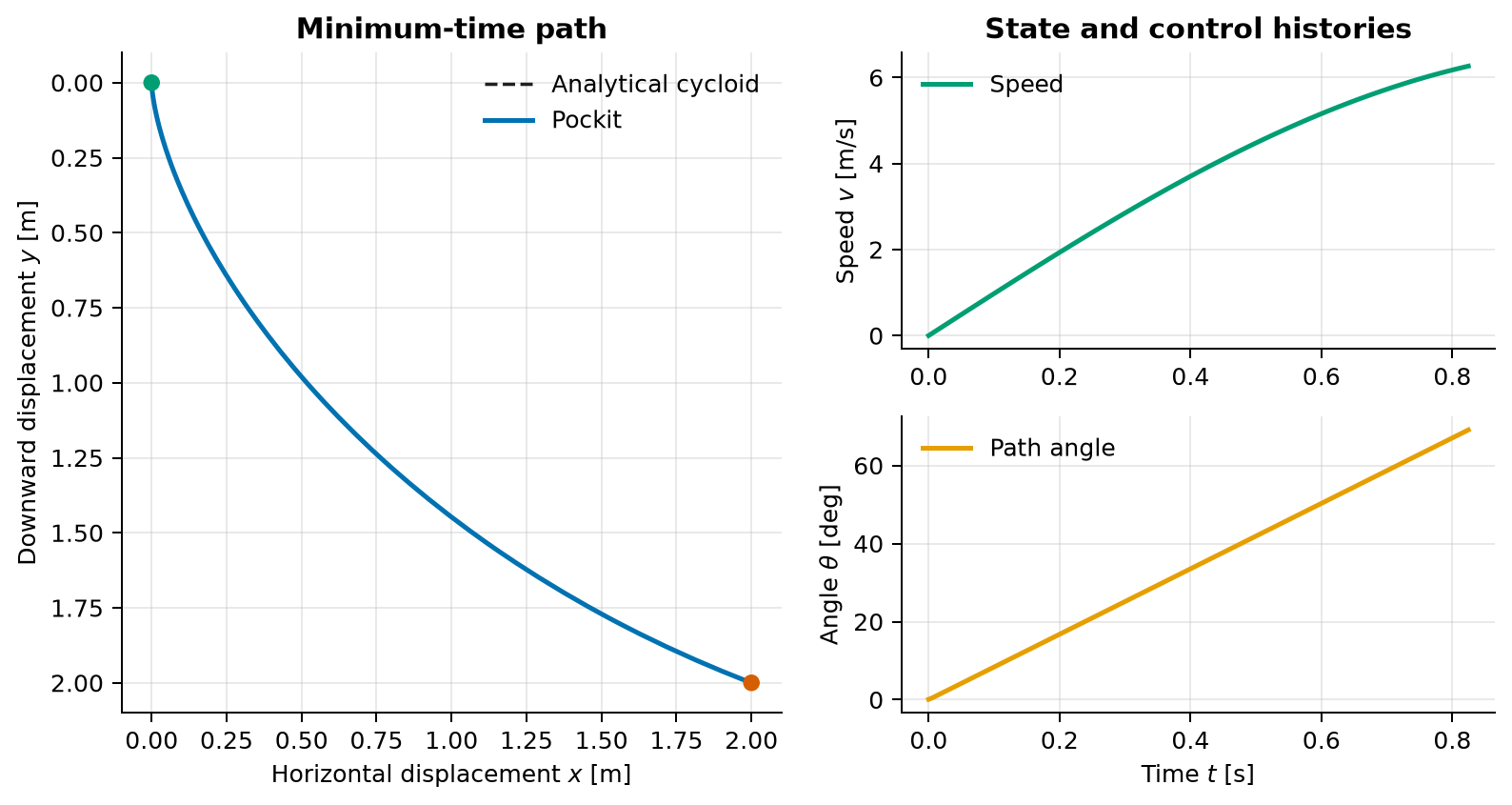
Pockit gives a minimum travel time of \(0.824338670697\ \mathrm{s}\). The analytical cycloid gives \(0.824338669439\ \mathrm{s}\), a difference of about \(1.3\times10^{-9}\ \mathrm{s}\). The plotted numerical path is visually coincident with the cycloid.
Source code
See the complete runnable example: examples/brachistochrone.py.