pockit: Python Optimal Control KIT.
Pockit is a Python toolkit for continuous-time optimal control and trajectory optimization. Define dynamics, costs, and constraints with SymPy expressions; Pockit transcribes them with Radau or Lobatto collocation and supplies sparse derivatives to Ipopt or SciPy.
Start with a working solve
Create the recommended environment from conda-forge:
The conda package includes both the Ipopt and SciPy backends; matplotlib adds
the plotting support used throughout the tutorials and examples. If conda is
unavailable, see the PyPI alternative.
The minimum-time double-integrator tutorial shows how to
set up the model, construct an initial guess, solve the problem, validate the
result on a dense time grid, and plot the solution.
| Goal | Go to |
|---|---|
| Install Pockit | Quick installation |
| Build and verify a first model | Solve your first problem |
| Understand transcription and collocation | From optimal control to a sparse NLP |
| Decide between Ipopt and SciPy | Optimizer selection |
| Define dynamics, bounds, and objectives | Problem setup |
| Connect phases through events | Multi-phase modeling |
| Diagnose an inaccurate transcription | Error checks and mesh refinement |
One workflow across domains
Maintained examples use the same composable structure:
system, phase = build_problem()
guess = initial_guess(phase)
solution = solve_problem(system, guess)
figure = plot_solution(solution)
Each example page states the continuous-time model, units, boundary and path constraints, discretization, and independent numerical checks. Reported results are reconstructed on dense physical-time grids rather than accepted solely from collocation nodes.
Examples by discipline
The maintained suite contains 33 runnable examples covering 23 conservatively grouped application areas. The navigation consolidates them into 12 broader groups, while the table below preserves the 23-area scope. Each linked page includes the background, equations, units, constraints, assumptions, limitations, and numerical checks.
| Discipline | Maintained examples | Main modeling idea |
|---|---|---|
| Mathematics and variational problems | Brachistochrone | Nonlinear mechanics checked against an analytical cycloid |
| Control theory and numerical benchmarks | Double integrator, LQR, hyper-sensitive problem | Free time, Riccati verification, bang-bang control, and boundary layers |
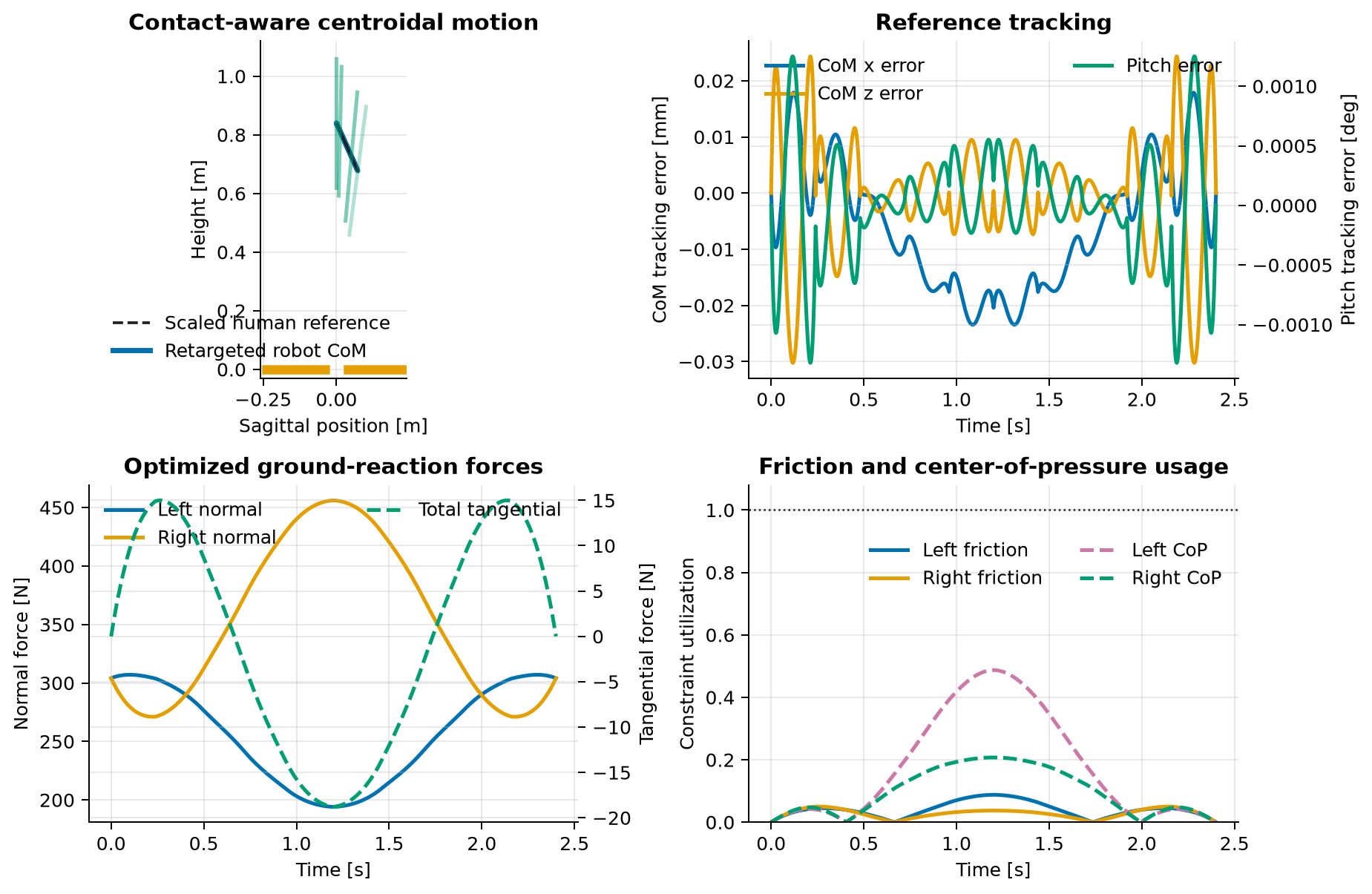
| Robotics | Robot arm, free-flying robot, humanoid OSC/WBC, humanoid retargeting, planar quadrotor, 6-DoF drone | Coupled motion, task hierarchy, contacts, and nonredundant attitude coordinates |
| Aerospace engineering and astrodynamics | Earth-to-Venus transfer, two-stage rocket, Mars powered descent | Orbital elements, staging events, and constrained landing guidance |
| Planetary science and small-body operations | Bennu soft landing | Rotating-frame proximity dynamics, surface approach, and low-thrust guidance |
| Astronomy and precision pointing | Flexible telescope slew | Input shaping and residual-mode suppression |
| Physical oceanography | Ocean inertial current | Coriolis dynamics and a controllability-Gramian forcing benchmark |
| Structural engineering | Structural vibration control | Active damping of a flexible mode |
| Chemistry and reaction engineering | Batch reactor, reaction selectivity | Operating-regime changes and competing reaction pathways |
| Transportation engineering | Electric-vehicle eco-driving | Road phases, speed limits, and energy-time trade-offs |
| Epidemiology and public health | SIR intervention | Nonlinear transmission dynamics and a health-care capacity limit |
| Biomedical engineering and neuroscience | Neural stimulation | Minimum-effort excitation of nonlinear membrane dynamics |
| Building science | HVAC demand management | Thermal storage, comfort bounds, and time-of-use prices |
| Energy systems and electric power | Battery arbitrage | Conversion efficiency, terminal inventory, and cycling cost |
| Pharmacology | PK infusion | Multi-phase loading, effect-site delay, and steady maintenance |
| Quantum physics | Two-level state transfer | Bloch-sphere control with an analytical fluence bound |
| Macroeconomics | Ramsey growth | Intertemporal consumption and investment allocation |
| Quantitative finance | Optimal trade execution | Inventory risk and temporary market impact |
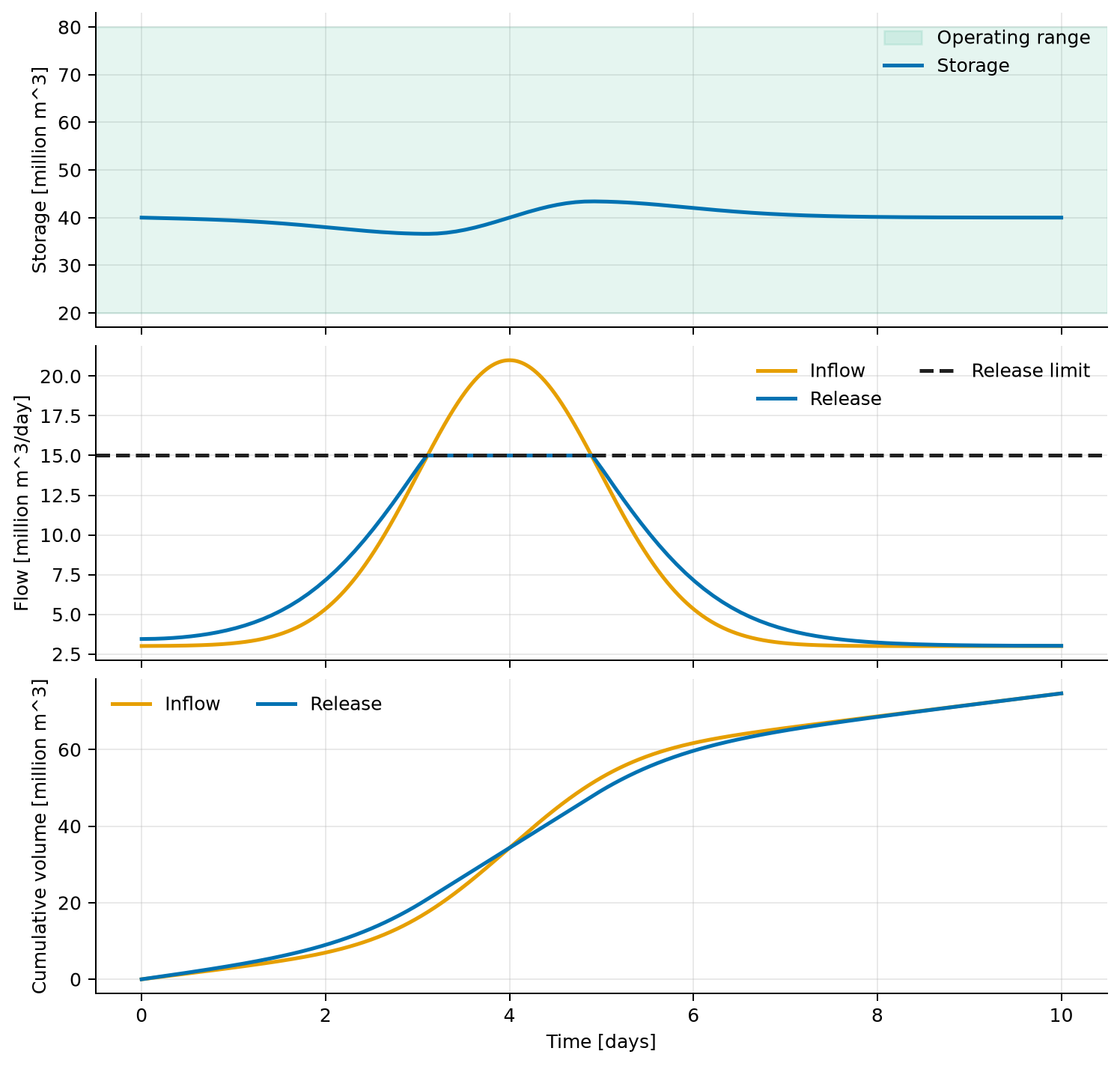
| Water-resources engineering | Reservoir flood control | Storage routing and constrained downstream release |
| Agricultural water management | Irrigation scheduling | Root-zone balance, rainfall, drainage, and crop stress |
| Ecology and resource economics | Bioeconomic fishery | Renewable stock dynamics and sustainable harvest |
| Communications engineering | Wireless transmission | Deadline-constrained water-filling power allocation |
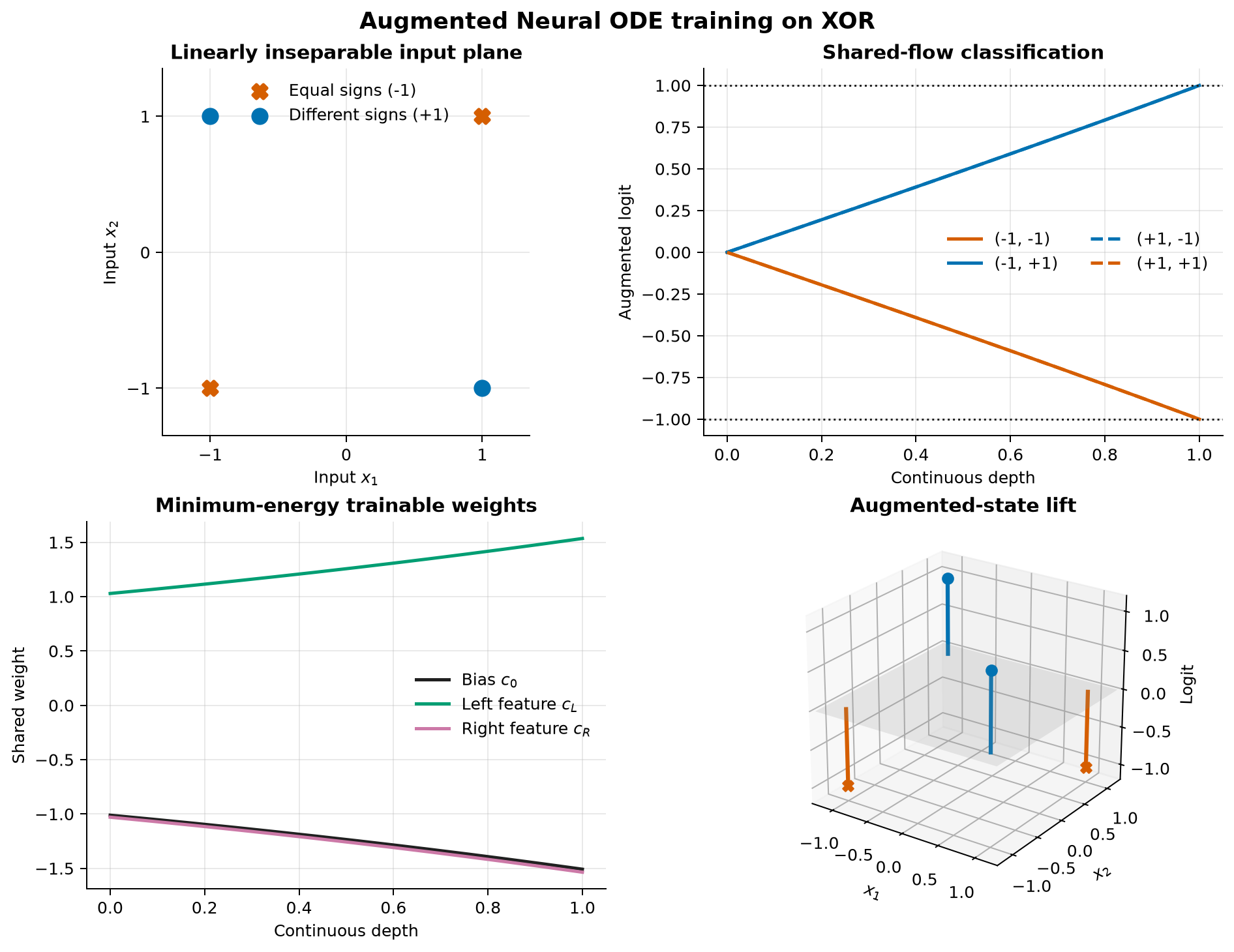
| Scientific machine learning | Neural ODE XOR | Continuous-depth training with an analytical classifier check |
Representative verified results
Core modeling capabilities
- Radau and Lobatto direct collocation with polynomial state and control interpolation
- Single- and multi-phase systems with phase-local dynamics and shared static parameters
- Fixed or free phase times, endpoint conditions, path constraints, event equations, and integral terms
- Symbolic sparse first- and second-order derivatives with reusable compiled functions
- Ipopt for large sparse nonlinear programs and SciPy
trust-constrfor a pure-Python backend - Continuous-time reconstruction, dense feasibility checks, and optional mesh updates when a first discretization is insufficient
Related project
For users who want a compact C++20 runtime backed by generated model code, see naive-planner. Its generated C++ evaluation path can substantially improve runtime performance. In one benchmark against Pockit, runtime fell to about one-tenth. Actual speedups depend on the problem, discretization, and solver settings. The project combines multi-interval Legendre-Gauss-Radau (LGR) collocation, SymPy-generated sparse analytic derivatives, and an Ipopt solver interface.
Known singular-arc limitation
Pockit does not currently provide a reliable, validated workflow for true singular arcs. Solver convergence alone is not certification. Read Singular Arcs: Identification and Current Limitations before modeling a control-affine problem with a suspected singular interval.
Continue with installation, or open the first complete solve.